
AI Paper Referee
revise-applied-paper is a Claude Code skill that referees and
revises an applied economics paper (.qmd, .md, or .tex) against the writing standards in
Marc F. Bellemare’s Doing Economics
(MIT Press, 2022). It reads your draft the way a journal referee would, writes a referee report, and
then revises the manuscript against that report — leaving a paper trail you can diff across drafts.
The code lives on GitHub.
This is a writing-craft tool, not scientific peer review. It helps the practitioner write a better paper by checking the manuscript against Bellemare’s recommendations on structure, exposition, and presentation — does the introduction follow Head’s formula, is the data section complete, are the tables self-explanatory, does the abstract read for a general audience. The “referee report” it produces is about how the paper is written, not about whether the economics is correct. It does not judge the validity of your identification, the soundness of your model, the correctness of your results, or the merit of your contribution. Treat its output as an editor’s read for clarity and convention — never as a verdict on the scientific or academic substance of the work. That judgment remains yours and your actual referees’.
Why it exists
Applied papers get rejected for avoidable writing reasons — a buried research question, a thin data section, an introduction that overpromises, tables a reader can’t reconstruct. Bellemare wrote down the unspoken norms that prevent this in Doing Economics. This skill turns those norms into a repeatable check on your own draft, structured as a journal R&R, so the same discipline a good co-author would impose gets applied to every revision.
How it compares
Plenty of AI tools will critique your writing. The difference here is its standard of reference: this skill audits your draft against a published, widely cited book on how applied economists actually write, so its comments trace back to an authority you can cite — not to a model’s improvised opinion. The rest of the trade-off against hosted, paid reviewers looks like this:
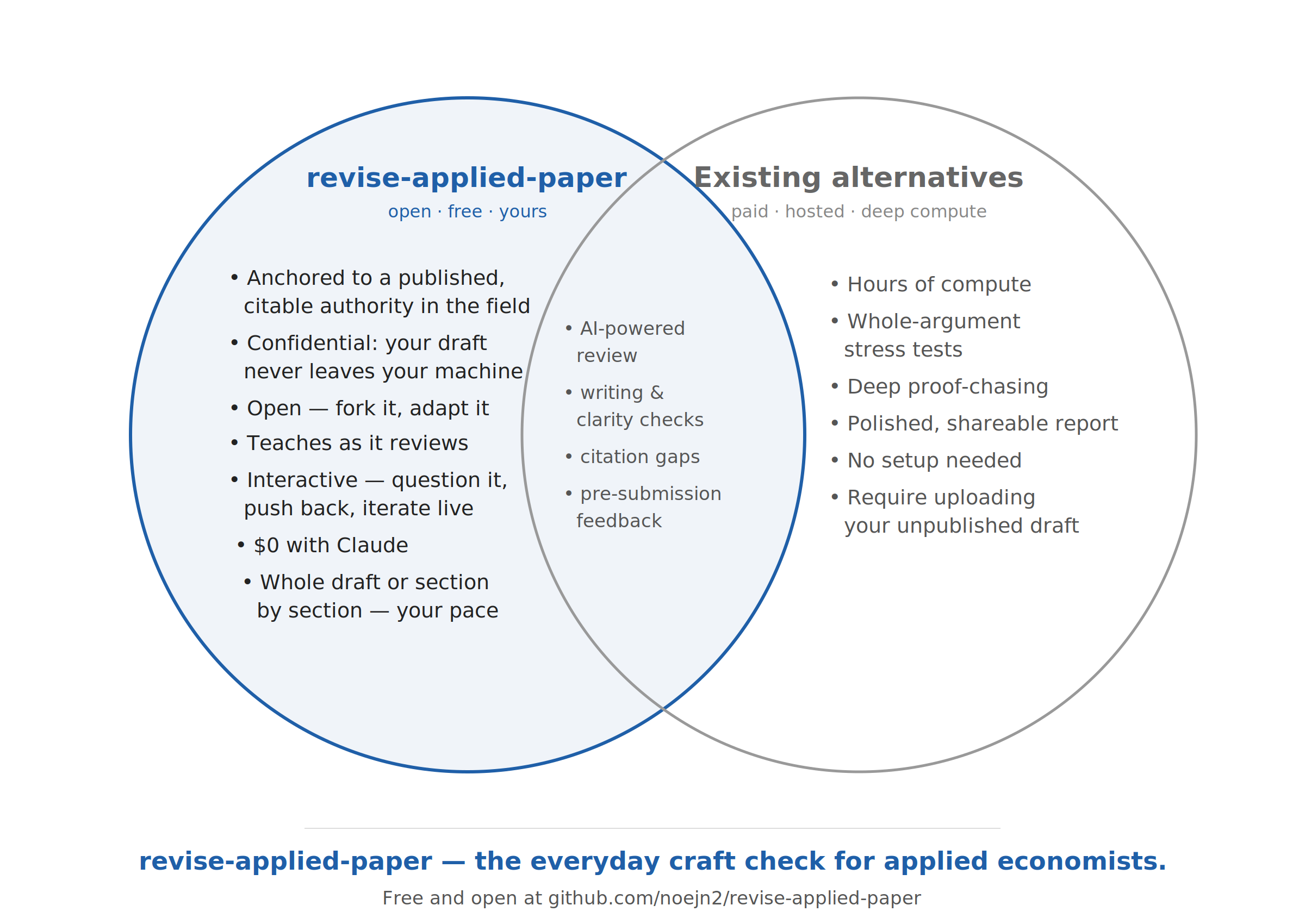
Both approaches overlap on the basics — AI-powered review, writing and clarity checks, citation gaps, pre-submission feedback. They diverge on everything else:
- revise-applied-paper (open · free · yours) is anchored to that citable authority, runs locally so your unpublished draft never leaves your machine, costs $0 on top of Claude, is open to fork and adapt, teaches as it reviews, and stays interactive — you push back on any comment and iterate live, on a whole draft or section by section, at your own pace.
- Hosted alternatives (paid · hosted · deep compute) trade those for raw horsepower: hours of compute, whole-argument stress tests, deep proof-chasing, and a polished, shareable report with no setup — at the cost of uploading your unpublished work to someone else’s servers.
In short: reach for a hosted reviewer when you want a heavyweight, one-shot stress test; reach for this when you want an everyday, private, authority-grounded craft check you control.
How it works
The skill simulates a round of review in three steps:
- Cold review. A fresh subagent reads your manuscript without your conversation context — like a real referee who didn’t watch you write it — and audits it against an ~80-item checklist distilled from Bellemare’s Doing Economics, walking every item section by section and running style sweeps (tense, passive voice, code-style variable names in tables, over-precise decimals, unsupported causal language).
- Referee report. The findings are written up as a referee report — a summary of the paper, numbered major comments (structure, data provenance, bait-and-switch, overclaiming) and minor comments (tense, notation, tables, abstract polish) — and saved next to your paper.
- Revise. Editing-level comments are applied to the manuscript; substantive ones that need new analysis or your judgment are parked in a to-do ledger (never fabricated); every comment is answered in a response memo.
Run it once interactively — it shows you the report and lets you strike items before any edit —
or in loop mode (--loop N), where it runs several autonomous rounds, each new round verifying
the previous round’s fixes and stopping early when a round raises no new major comments.
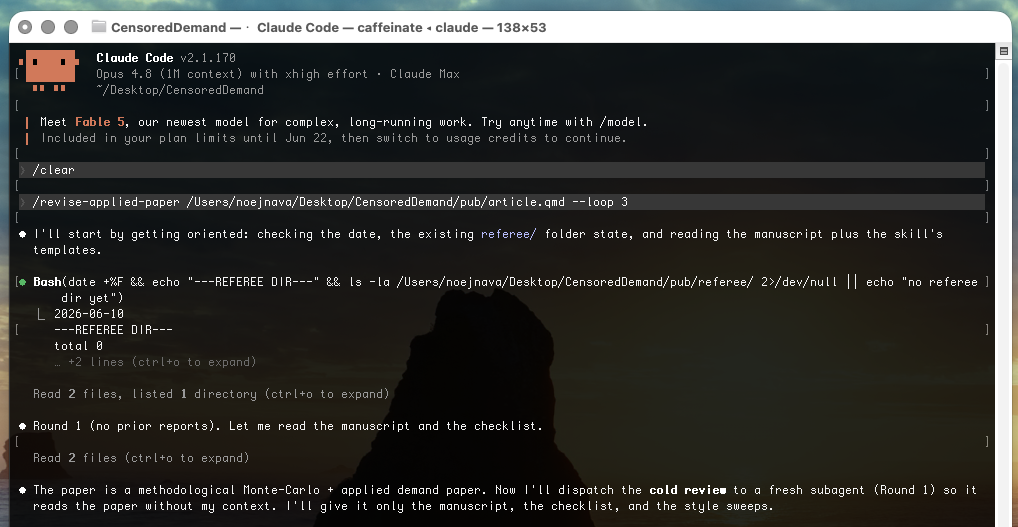
Everything persists in a referee/ folder beside your paper, so the reports are diffable across
drafts and double as a rehearsal for your real response-to-reviewers later:
referee/
├── referee_report_<date>_r1.md   # one per round
├── response_memo_<date>_r1.md    # every comment → applied / parked / declined
├── needs_author.md               # substantive items only you can address
└── declined.md                   # items you struck, with your reason
Usage
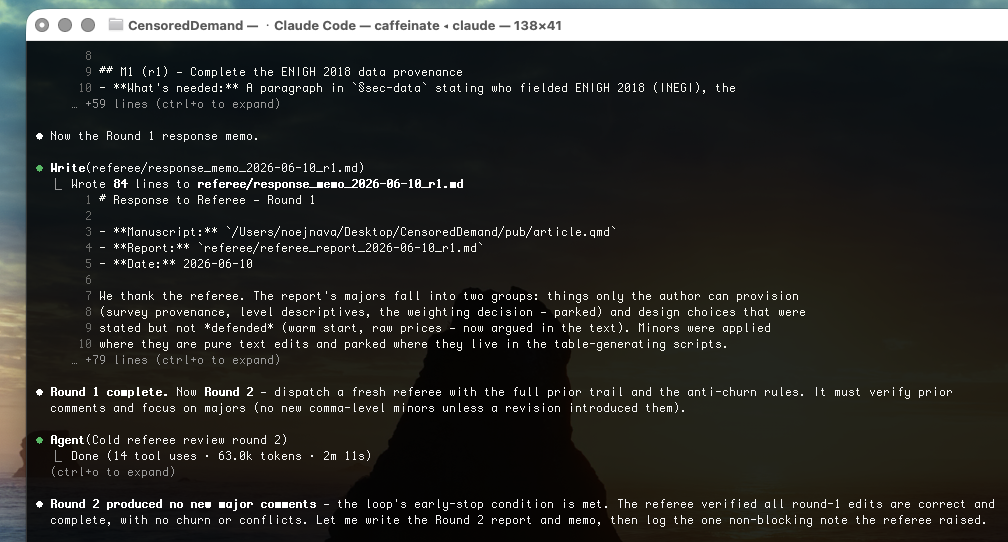
/revise-applied-paper article.qmd            # one interactive round
/revise-applied-paper article.qmd --loop 3   # up to 3 autonomous rounds
It also triggers automatically when you ask things like “review my introduction” or “check this draft against applied-econ norms.”
A real run
Run on an actual working paper — “The cost of common simplifications in censored demand-system estimation” — in loop mode with a cap of three rounds.
The loop ran 2 of up to 3 rounds and stopped early: Round 2’s referee verified every Round-1 edit and found no new major comments. The summary lists what was applied to the manuscript by section and what was parked for the author. A few of the real comments from behind this run:
M1. Data provenance is incomplete for a real-survey application. §sec-data names “ENIGH 2018” and “roughly 61,600 households” but gives no fielding agency, collection dates, sampling design, or the rules that produced n=61,599. Fixable by editing: no — needs the author’s knowledge.
M5. Raw-vs-corrected price framing risks a bait-and-switch. The abstract promises “the real ENIGH 2018 data behind Nava & Dong (2022),” but the body presents only raw unit-value results and a table caption points to a corrected-price comparison the body never shows.
m3. [abstract] Dense with unglossed jargon for a non-economist — “Tobit,” “Stone price index,” “translog,” “QUAIDS,” “bias floor” → lightly gloss the most technical terms.
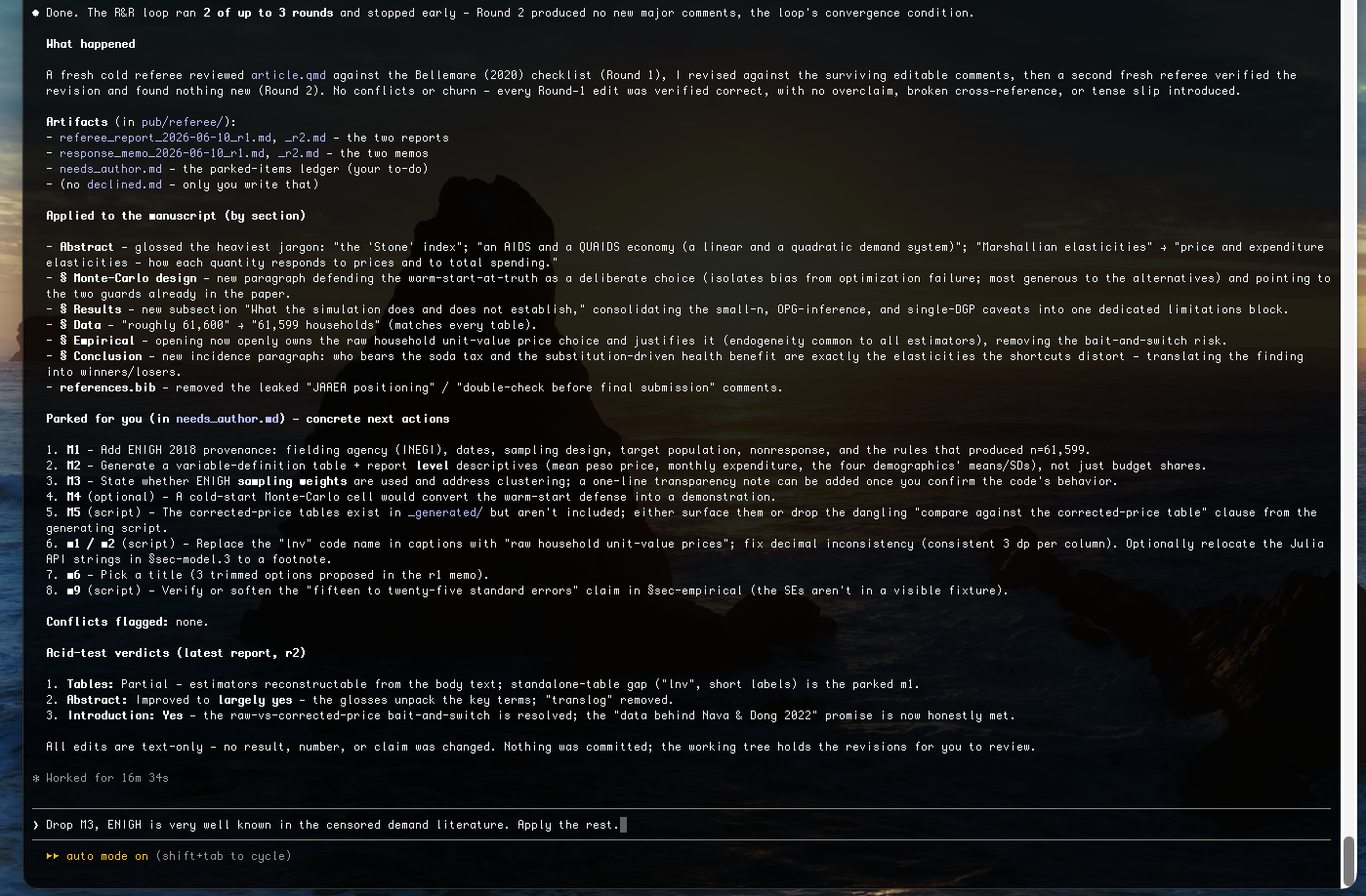
You stay in control. The report is a checkpoint, not an autopilot. Each comment is laid out so
you can apply it, park it, or strike it — here the author declines one comment (“Drop M3, ENIGH is
very well known in the censored demand literature”) and it’s recorded in declined.md with that
reason while the rest are applied.
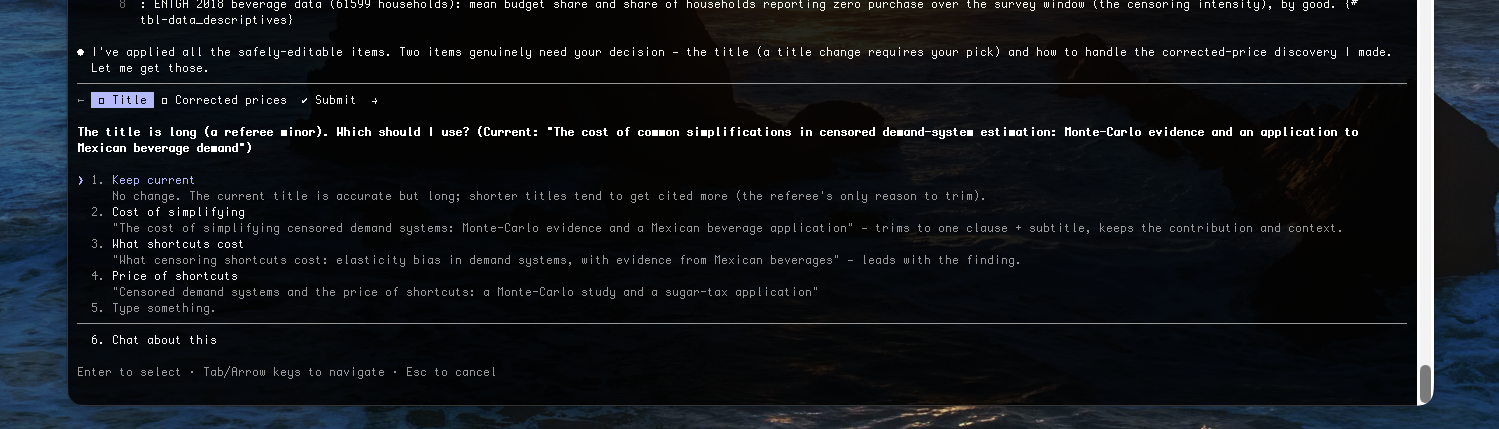
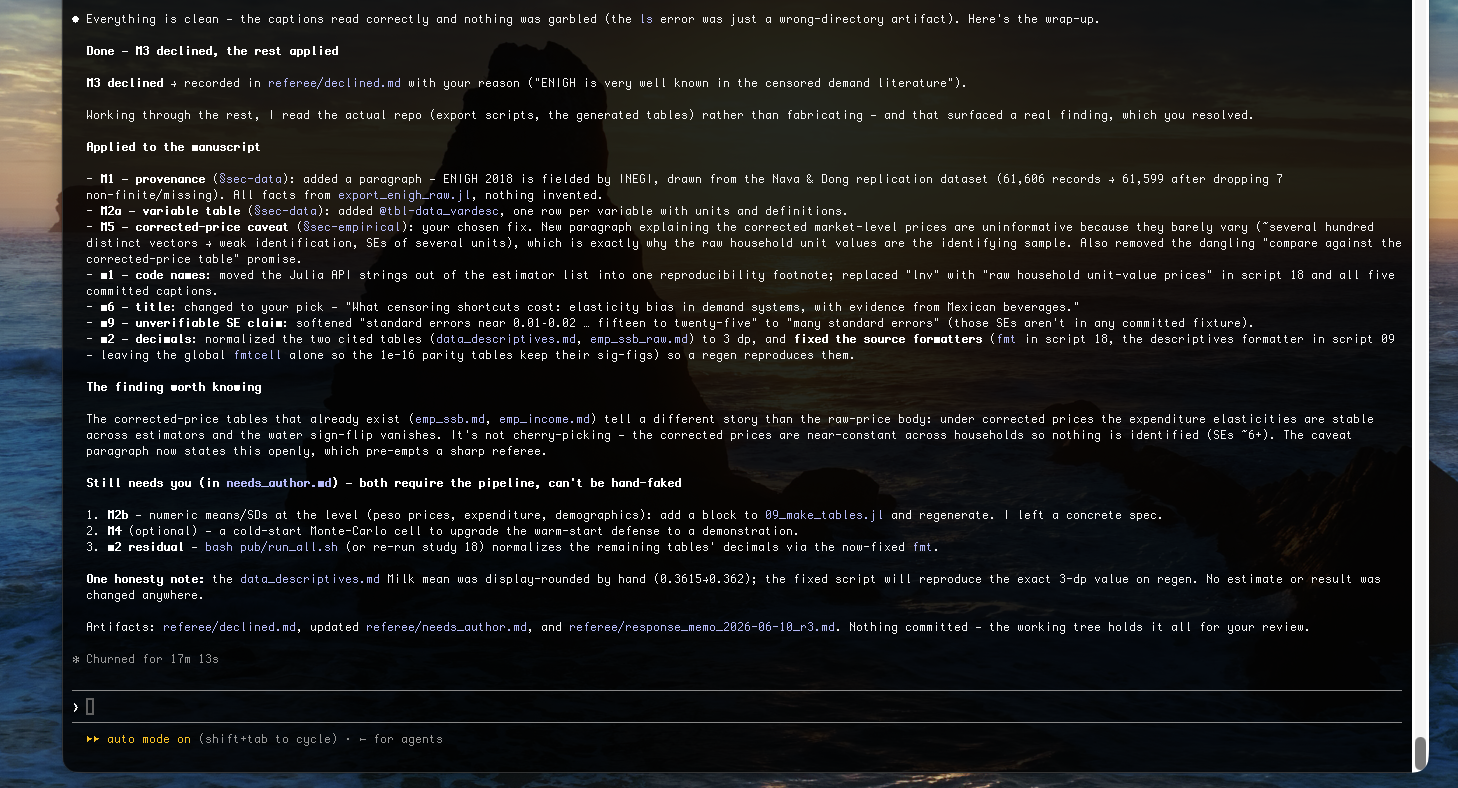
Crucially, the skill read the actual repo rather than fabricating, which is what surfaced the real M1 finding, and it changed only prose — “no estimate, number, or claim was changed anywhere.” What landed in the manuscript were writing fixes (a provenance paragraph, a variable-definition table, plain-English variable names, a glossed abstract, a consistent decimal format). What it would not touch — and parked for the author instead — were things requiring new analysis or judgment (regenerating tables, a cold-start Monte-Carlo, the weighting decision). That line is exactly the point of the disclaimer at the top.
Running it — what to expect
A run is a long, token-heavy agentic session rather than a single prompt. The referee reads the whole manuscript cold, walks every checklist item, and — in loop mode — does it again each round to verify the last round’s fixes. Because the conversation transcript is re-read on every turn, the bulk of what the session consumes is context being read back, not new text being written, and a full multi-round run takes on the order of tens of minutes of wall-clock.
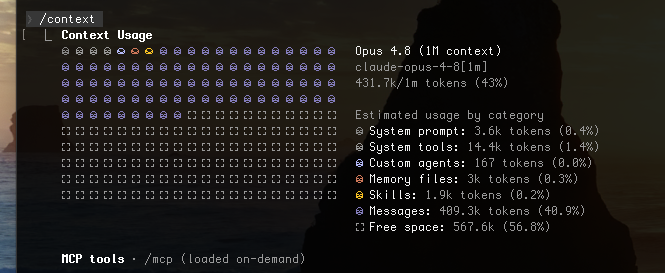
A few habits keep a run lean:
- Use a smaller
--loop. Most of the value — the cold review plus one revision — lands in the first round or two; a third round is mostly a verification pass.--loop 1is the cheapest useful unit,--loop 2captures nearly everything. - Let it run autonomously. Each mid-run nudge adds a turn, and every turn re-reads the whole transcript. One well-specified kickoff costs less than many small interruptions.
- Shorter manuscripts cost less per round, since the cold-review referee re-reads the full paper on every round.
Installation
The skill must live in ~/.claude/skills/ to be active. Clone it there, or clone anywhere and
symlink:
git clone git@github.com:noejn2/revise-applied-paper.git
ln -s "$(pwd)/revise-applied-paper" ~/.claude/skills/revise-applied-paper
Then run /revise-applied-paper <your-draft> in any project.
Credit
All of the substance here is Marc F. Bellemare’s. The checklist distills the chapter on writing applied papers from his book Doing Economics (MIT Press, 2022). For the real thing, read the book and his blog on academic writing — and Keith Head’s Introduction Formula, which it relies on.